
Chthonic Creations

Section 1: The Calculus of Board Quality
I have spent the better part of two decades navigating games where the difference between a win and a loss is measured in thin mathematical margins. From middle-school Magic: The Gathering to making three Pro Tours and finding a seat at the poker table, my approach has always been about identifying the correct play rather than the flashy one. After a run in the Gwent Beta where I maintained a 60% win rate by ignoring the popular net decks in favor of my own builds, I’ve now turned that same analytical lens toward Arkham Horror: The Card Game.
This journal is a documentation of where I am starting—a baseline for my early deck-building logic so I can look back later and see how my perspective has shifted.
The core of my strategy rests on a single metric: Value. In this context, Value is defined as the Expected Board Quality of a card. I don’t care about community consensus or flavor; I care about what a card actually contributes to the table when the pressure is on. To me, building a deck is like balancing a range in poker. You don’t just play the strongest cards; you play the cards that make your entire strategy resilient. Sometimes you have to make a lower-tier play—like committing a simple skill card—to protect your high-stakes assets for the moments they are actually required. It’s about not over-committing when you don’t have the edge and knowing exactly when to push when you do.
In these entries, I’ll be categorizing my draws as either Duds or Fine. A Fine draw isn’t necessarily a winning hand; it’s a hand that gives me the tools to maintain a stable board. If shit happens in the mythos or I draw a bad tentacle token that shouldn’t effect my analysis. A Dud is a statistical failure—a hand that offers no path to progress. By tracking these subjectively, I can see if my 50-card builds are actually providing the reliability I expect or if I’m just bluffing myself into thinking they are more stable than they are. We’re looking for the point where the setup phase ends and the deck starts paying out.
Section 2: The Variance of Volume — Mandy and Suzi
When you sit down with a 50-card deck in a game designed for 30, you are intentionally inviting variance into your range. In most competitive environments, this is a mistake unless the payout for that increased volume is high enough to offset the lack of consistency. For Mandy and Suzi, the trade-off is the core of their strategy, but they execute it with completely different levels of immediate impact.
Mandy Thompson is arguably my strongest investigator, and despite her 50-card requirement, she doesn’t actually suffer from a slow start. Her search velocity is so high that she effectively thins her own library every time she takes an action. In my [Worm Sign] Deck, she is a pure clue-getter who hits the ground running. She isn’t guessing what she’ll draw next; she is selecting the exact tool she needs for the current problem. By the time we reach the [EXP 50 Version], she becomes a Super-Turn generator. Between free moves and extra actions, she can clear a location of clues before the rest of the team even finishes their setup. Her reliability is her greatest asset; because she sees so much of her deck so quickly, the Expected Board Quality of her turns is consistently at the ceiling.
Subject 5U-21 (Suzi) handles the 50-card variance differently: she is a long-term project. She is the definition of a full flex character—someone who can adapt to any role the table needs—but she requires patience. My [Yummington 1859] starts from a point of extreme weakness; she begins every scenario with base 1 stats across the board. The mechanical gamble here is the setup. You spend the first few turns just trying to survive, feeding cards into her permanent engine to raise those stats. It feels like playing a short stack in a tournament: you have to be patient, choose your spots, and wait for your stats to hit that base-6 sweet spot. In the [EXP 50 Version], the strategy shifts toward resource burst and card recycling to hit that power ceiling faster.
While the purpose of the game is to have fun, the objective is to win. Mandy achieves this through sheer efficiency and early-game dominance, while Suzi represents a calculated risk—you give up the early turns to guarantee you own the finish line. One is a refined engine that starts fast; the other is a meme project that I’ve optimized to become a late-game monster.
Section 3: The Attrition Engines — Yorrick and Lily
In any game with a combat element, you need a way to stabilize the board. If the clue-getters are the players making the big moves, the fighters are the ones protecting the pot. For Yorrick and Lily, the value isn’t just in how hard they hit, but in how reliably they can stay in the game.
William Yorrick is my most reliable 0-XP build. His [Thicket of Strays] is built on the idea that the discard pile isn’t a graveyard—it’s a second hand. Because he can play an asset from his discard every time he kills an enemy, he never truly loses his tools. This creates an infinite soak loop where items like a Leather Coat or a Cherished Keepsake provide a permanent safety net. In poker terms, Yorrick never has to fold; he just calls down until the mythos deck is out of gas. By the time we reach the [EXP 50 Version], his expected board quality shifts toward pure action density. With a Chainsaw and the ability to gain extra actions, he becomes a combat perimeter that is almost impossible to penetrate. He is the stable element of a 3-player team—the insurance policy that ensures the specialists can do their jobs without being interrupted.
Lily Chen takes a different approach to the same objective. While Yorrick is about recursion, Lily is about Stat Integration. She is a Momentum Fighter who relies on filling her arcane slots to fuel her weapons. In the [Dragon Lily], she can feel a bit more fragile because she has a setup tax—she needs to draw and play her equipment before she hits her stride. However, once she’s set up, her ability to convert willpower into combat damage is a high-impact play. The [EXP 50 Version] fixes her early-game inertia with permanents that guarantee her starting hand isn’t a Dud. She might not have Yorrick’s endless durability, but her peak board quality is explosive. She’s the investigator you want when you need to delete a high-health enemy in a single turn.
The gap between these two is the difference between Consistent EV and High-Impact Utility. Yorrick is the check-call specialist who wears the encounter deck down through pure attrition, while Lily is the big bet player who waits for her slots to align before swinging for the win. Both are essential for a blind run because they provide the one thing a clue-getter can’t: a way to hold the line when the math gets ugly.

Section 4: The Strategic Buffer — George Barnaby
If Mandy is about finding the answer and Yorrick is about recycling it, George Barnaby is about never letting the answer go. He occupies a unique Flex space in my roster, functioning as a high-intellect clue-getter who can also manage the board through sheer card volume.
The mechanical core of George’s [The Practice] is his ability to bank cards for later. By discarding cards to trigger free moves with Bound for the Horizon or testless clues with Nautical Charts, he tucks those cards beneath him and draws a replacement. This builds a secondary hand that increases his Success Probability on every subsequent test. In any game, having a larger hand than your opponent is a massive statistical edge; for George, it means he always has the icons to pass a critical test. He is the Resilient Flex—he isn’t as explosive as Mandy, but he is the hardest to tilt. With a 50-card deck and 31 skills, he has a safety net that protects him from the low-stat vulnerabilities that usually plague a specialist.
In the [EXP 50 Version], George becomes a Statistical Absolute. The transition into the late campaign adds tools like Cornered, which allows him to discard any card for a flat +2 bonus to a test. Because he can often tuck that same card to draw a new one, he creates a loop of Constant Success. He is the player who handles the garbage encounter draws so the specialists can stay focused. His expected board quality is defined by Persistence—the ability to clear clues steadily while remaining nearly impossible to stop, regardless of what the chaos bag or the mythos deck throws at him.
Section 5: The Strategic Synthesis
Documentation like this is a necessary exercise. It forces me to define Value before the noise of a campaign—the bad beats, the lucky pulls, and the inevitable trauma—clouds the data. Right now, my ranking of these investigators is based purely on their mechanical architecture. At 0-XP, Yorrick and Mandy lead the pack because their reliability is baked into their card pools. At 50-XP, Mandy and Suzi take the top spots because their ceiling for Super-Turns is mathematically higher than anyone else’s.
However, the real test of a deck isn’t how it looks on paper; it’s how it handles the Variance of an 8-scenario run. The purpose of this game is to have fun, and for me, that fun is derived from the objective of winning. Whether I’m playing the check-call game with Yorrick’s recursion or jamming the late game with Suzi’s base-6 stats, the goal is to minimize the Duds and maximize the Fine turns.
This journal is the Before snapshot. In a few months, I’ll look back at these builds and see which of my assumptions held up and where the encounter deck called my bluff. For now, the team is set, the ranges are balanced, and the math is in my favor. It’s time to see if the board quality matches the theory.
This is an interesting application of GTO principles to Arkham, but the primary risk in these builds—particularly the 50-card George and Suzi lists—is resource saturation. While the expected board quality of a "base-6 Suzi" or a "tucking George" is high, the mathematical "tax" to get those engines online in a 3-player game can be punishing. If the encounter deck draws early aggression or "ancient evils," these specialists may find themselves "blind-calling" into a loss before their search or scaling velocity can overcome the high-volume deck size. The reliance on a "Fine" opening hand is a significant variance risk that even a 12-card Mandy search can't always mitigate if the economy assets are buried in the bottom half of the deck.
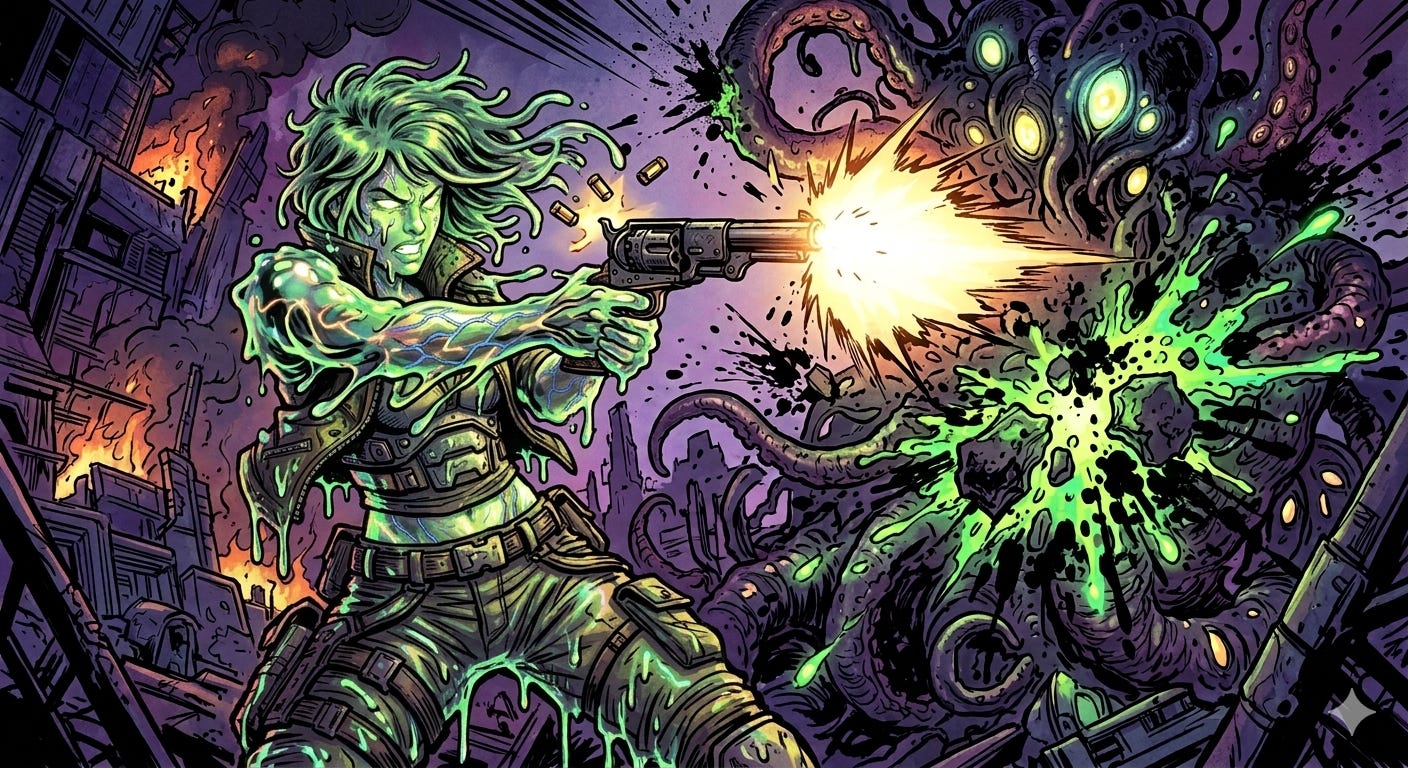
Note: This article and the accompanying cell-shaded illustrations were developed as a collaborative documentation project using a chatbot. All content and artwork are provided as free-use and are intended for open community discussion and strategy optimization.